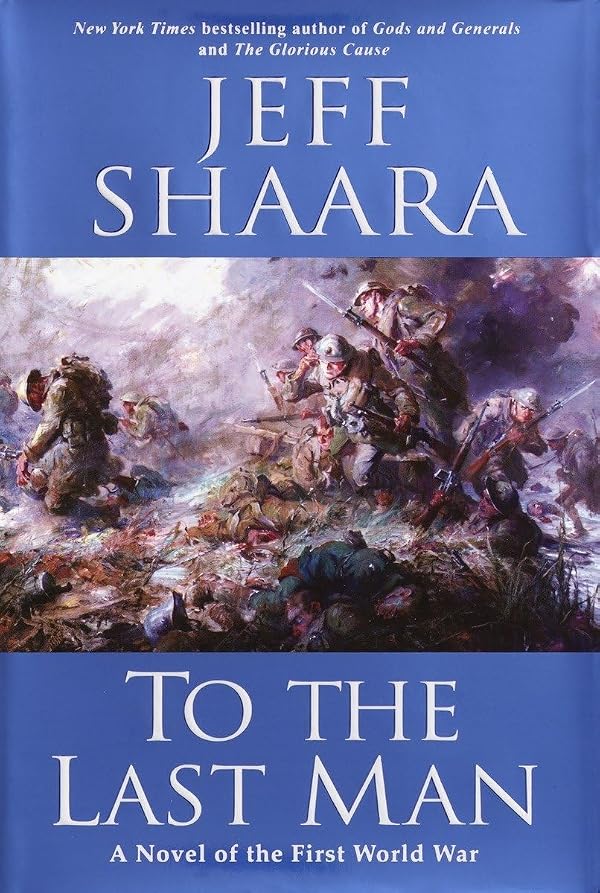
This is a story of the US’s role in World War I. It has two major threads which weave into three sections.
The first thread is about the politics of the war, the second part is about the role of the men fighting the war.
These threads are intertwined through the three sections. These sections represent phases of the US involvement: commitment and preparation, moving troops, and action. There is also a short post-war segment.
The author commented that he included a lot of personal stories and journals in his research, these people were included in the stories, there is a brief introduction to a few of them at the beginning and a short post-war history of many is included at the end of the book.
Dates are scattered throughout the book that helps tie events to a point in history. The book also includes a number of battle maps, I presume they are authentic and they helped me identify places of the actions, but otherwise didn’t really add any value to the story.
The book opens with an introduction of the war through the eyes of some soldiers including von Richtofen. Airplanes are first seen as a military tool, first for reconnaissance, then as combat tools. We are shown the formation of the first squadrons. Some Americans are drawn to the war as a good fight and the chance to fly. We are introduced to a number of the flying aces, such as Raoul Lufbery, and the formation of L’Èscradrille de Lafayette, a squadron of American flyers fighting under the French flag. This part of the book mostly follows the stories of Manfred von Richtofen and Raoul Lufbery.
In the second part America commits itself to the war but has no war capabilities. John Pershing is assigned based on his record in the Spanish-American War. He doesn’t receive any support and has to use his efforts and contacts to make things happen. He goes to France and ends up, to his own chagrin, being a bit of a politician as the learns of the different expectations of France and England on the type of support the Americans will provide. He has to fight their insistences that the US soldiers will fight under their flags.
This part still follows the air war as their equipment continues to improve along with their tactics. We see the death of both Richofen and Lufbery.
In the last part of the book we are shown the horrors of war. This is mostly about the experience of a foot soldier, Private Roscoe Temple. He feels the discontent of a soldier as he finds himself marching one way, then back without any information as to why, although as a reader we are privy to knowledge and discussions of Pershing. We encounter his life in the trenches, his discomfort from lack of food, water and clean clothes. Then as he sees his friends and comrades die.
Pursuing a German retreat we are shown a range of feelings and see him grow from a recruit to a veteran soldier.
There is a short post-war portion of the book that talks about the postwar politics as the allied powers discuss among themselves what kind of conditions that Germany should suffer. Pershing was omitted from the final ceremony because he and FDR wanted to offer Germany more consideration while France and England demanded an unconditional surrender.
Overall the book was enjoyable. I felt that some of the sections could have been shorter. It seemed that the French leaders fawned over Pershing a bit much, it didn’t seem natural nor reasonable for an official.
Then too much of the story was of the form of telling the reader rather than showing them. Much of it was first person seeing the thoughts of the current character. The story would have been better, if not longer, if a lot of this had been in a more interactive story form.
There was no mention of the 369th Infantry Regiment, knows as the Harlem Hellfighters who were assigned to the French army due to prejudice in the US Army. This is mostly significant since Pershing felt bad about it and commented that he would never do it again. I believe is it the only unit in our history that was assigned to fight for a foreign flag. It feels like it should have been part of this story.